
Glen Perotte Jersey Stamps Feature
March 3, 2026

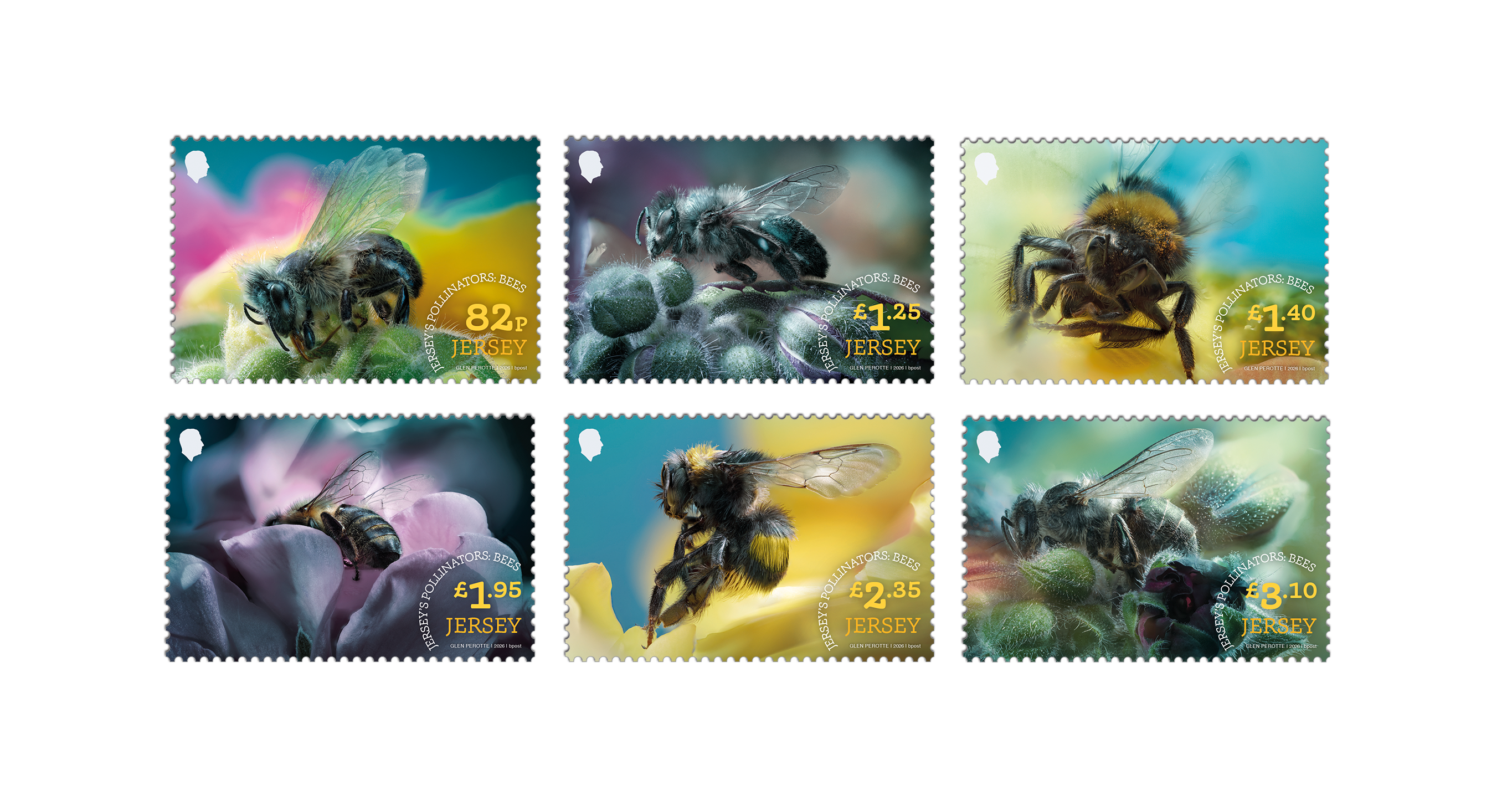
Have you been curious about how the images for the Jersey’s Pollinators: Bees issue was captured?
Glen Perotte, a photographer based in Jersey, used his skills developed over a number of years. To capture all the intricate details such as the plant’s trichomes (hair), he used a microphotography technique, which involves attaching a microscope lens to his high-resolution digital camera, using transmitted and reflected lighting, and taking a large volume of shots which Glen then blended using innovative software during the editing process.
We recently spoke with Glen to find out more about how he developed his skills as a photographer and what inspired him to pursue photography. Read on to find out more about his journey.
When did you know you wanted to make photography a career?
I discovered my passion for photography at a young age. While I was in high school in the US, I took part in a work-experience placement—similar to the Trident program in Jersey— with a commercial photographer in New York. That opportunity confirmed for me that this was what I wanted to do, and after I graduated, he offered me my first position working as his photographic assistant.
If you hadn’t become a photographer, is there a different industry you would have wanted to try out?
I was originally drawn to filmmaking and seriously thought about pursuing that path before ultimately choosing photography as the focus of my career.
Are you self-taught or did you attend a course/study at university?
My photography education began on the job, working as an assistant to top advertising photographers in New York and London. Later, as a mature student, I chose to pursue formal studies that would strengthen my skills and broaden my creative perspective. I earned a bachelor’s degree in graphic design and a master’s degree in Instructional Technology—each of which I felt would contribute to making me a better photographer.
Where do you get your inspiration for each shot?
My inspiration comes from across the creative spectrum. I constantly immerse myself in all forms of visual storytelling, including fine art, design, filmmaking, and of course photography.
Have you seen any new trends you want to try in your own work?
I generally try not to follow trends, as I believe that, from a creative perspective, creating images must come from the heart. However, I do make sure to stay close to advancements in technology; I find this is essential for keeping my work fresh and relevant.
Are there any photographers that inspire you with your own work?
I have always been deeply interested in the history of photography, so I often study and find inspiration in the work of the early pioneers. Regarding more contemporary influences, I greatly admire Albert Watson and Edward Burtynsky, as well as the recently passed, Sebastião Salgado.
What’s your favourite type of subject to photograph i.e. people, fauna, flora etc.
I began my commercial career as a still-life and product photographer, but I incorporated portraiture very early on. I truly enjoy both genres equally. Given my background, I now enjoy shooting a wide range of subjects here in Jersey, including portraits, products, architecture, and food.
For my personal work, I am particularly drawn to the natural world, specifically flora. This interest stems from my early experience in still-life photography, which naturally influences how I capture botanical subjects.
Is there a quote you go by in life/photography career?
Early in my career, I singled out a particular ad agency in London that was doing incredible award-winning work. I persistently followed up with the creative director, regularly emailing him and sharing my latest images. After an extended period, he finally called me in for a job. When we met, the first thing he said to me was, "Persistence gets you everywhere." That quote has stayed with me throughout the years.
What's the most interesting fact you learnt about bees by working with Jersey honey?
Working on this project was a wonderful experience of discovery, and I found the entire process incredibly interesting. Shaun Gell of Jersey Honey passion was truly inspiring; during my visits to his hive site, he taught me so much about the life of bees.
If I was to signal out one interesting fact I learned: it would have to be how bees see. They can perceive light in the ultraviolet spectrum, which is invisible to humans. This ability allows them to easily spot and navigate toward the nectar and pollen in flowers.